Wednesday, July 21, 2021

2006 - Leadership - It's Not About Me


Matt' Copperhead" Sheah

(Fifty Nifty Years in the United States Series)

Several times I have tried to update Wikipedia – I have submitted Matt’s name and profile to go with the word “Loyalty.” I am unclear why they do not accept this. Anyone who has worked or known Matt Sheah knows of his loyalty and devotion. His camp name is “Copperhead."

He got that name on the third time I met him. He had just arrived at the camp I was running in Florida from 2004-2009. Several of us were down at the spring trying to figure out how to remove a snake from near the pier. Matt walked up, assessed the situation and moved to action. He walked up to a utility truck, took out a large screw driver, walked down to the water, stabbed the snake in the back of the head and removed it.

Not actual picture of Matt and the Copperhead (shown for size estimate only)

It has long been noted in my family (Ferreira) that we are heirs to the throne in Portugal. Some circumstantial evidence supports that – at best. In the knights of old, there was always a knight that protected the King’s family. Loyal to a fault and would give anything and always had the royal family in his best care. So, should some series of circumstances all for my family’s  return to power in Portugal, I would have Matt as my Minister of All Things.

All joking aside, Matt is one of the best people I have had the opportunity to work with in all my years. That has been Matt Sheah and did I mention he is a black belt; and an Eagle Scout; and a teacher; and a husband; and a exceptional father; and a great person; and so much more including my friend.

It was at our second camp that we officially adopted INAM as a staff philosophy. For those who are unfamiliar with INAM - it stands for "It's Not About Me." Several dozen (maybe hundred) times in my career and life, I have had moments where I made the mistake to focus on what I needed and lost focus on how to serve. At the camp in new York, it was a dominant culture with the leadership. Upon my arrival, I met with no less than 17 different folks who informed me that they had "director" in their title. It was in those conversations that I asked about who actually worked directly with children and not a single one of those folks did.

Matt and I began a culture change process and formerly adopted the INAM as a way to instill focus on our mission, "serving youth." 

When I think about the terrible things that happen in the news about our world, I know that Matt is hope for the future. His influence with young people gives me great hope. When I was offered a position to change camps and move 11 states away, Matt was the first person I asked to help me move and in my mind, I thought if I could just get him to come along I would get to continue working with him. Somehow that plan ended up working and I got to work with him for two more years.

It was his loyalty and his fervent support of whatever agenda I had. In private we would discuss and disagree. And when we were in front of our team, he would always forward the agenda and culture. It is a value that I learned from him and I did not consider how much I valued that until I was no longer working with him. 

Matt has always furthered the mission of sharing the outdoors and leadership with so many youth. John Maxwell's 11th Law of Leadership is that of the Law of the Inner Circle. John talks about it being the company you keep and how that reflects back on you. I have been so fortunate to be in Matt's inner circle at two different camps serving thousands of youth and leaders. If my potential is determined by those closest to me, than I am better for having Matt influence my life and work,

I have had the fortune of working with Matt, who is an exceptional person and I am extremely grateful for having had him as part of my 50 plus years in these United States.


Friday, July 9, 2021

2005 - Leadership and Learning

Megan with Stanley (A future BLOG story - Megan's the human)

(Fifty Nifty Years in the United States Series)
 
I always want to be there when she learns new things. One of the most delightful people I have had the opportunity to know and work with. It is clear the she is and always will be a lifelong learner. And that contagious learning makes me smile to this day.

I have always considered myself a life-long learner and to this day, I know that as I get older, I realize the less I know. Megan came aboard our lives at the Camp in Florida. She was an intern that I am sure I had work on multiple projects including our new grant funded after school program and our accreditation with the American Camp Association.

Our conversations always gave me a “pick me up” when it came to learning leadership. I felt I always walked away with more than I left. It was her exuberance to learn and grow that is one of her most compelling traits. I cannot recall a single conversation that she wasn’t sharing something other than what she had just learned about herself, a class or a life lesson.

Several years later she recounted a time where she wanted to buy radios for camp for us to have better communication. I challenged back that we needed to have better communication with our team to even consider using radios. She called it a “lesson in communication.” Truth be known, I thought of it as a, “oh my gosh we can’t afford radios at this moment.”

And by the way, she led the way and improved how we all communicated as a team.
Support Staff (aka Directing Team) circa 2005


At that time, I had been utilizing the MyersBriggs personality assessment to determine how best to place co-leaders in a cabin. (Click the link above to take a free test and comment your type)

I had originally had a less complicated system by determining how to do so by watching leaders interact during our staff orientation week and then having a late night gathering with support staff (what I called my directing team) and arguing sometimes for hours about who would best fit with whom. We seldom had 50-50 odds that it would work out.

After I began using Myers Briggs, our odds shot up to 80% success rate. There are some MB personalities that work amazing together and some personality types that you do not ever, ever place together. I also began using the Myers Briggs assessment to determine how best to predict how our support staff team would work and communicate.

Knowing their types, I employed an evening of playing Castle Risk (a variation of the Hasbro/Parker Brothers RISK) with the support staff team. Megan, as I recall did not enjoy the experience. Matt Sheah reminded me that it wasn’t so much that she disliked the experience; it was more a hesitancy to “thin out” our teammates in the game. She did not want to go against the team. The end result of an evening of play, was that it would magnify the leadership communication styles for each person. It was a great predictor of how communication would occur.

As a lifelong learner, Megan demonstrated and continues to do so, a purpose driven life. She approaches everything in that manner and it allows her enthusiasm to be contagious and for those who are learning along with her, to reach a higher degree of success.

Matt and Megan helped redesign out Leader-In-Training program into the three year arc that I have used at multiple camps with a greater degree of skills based learning. I long have maintained that camping is in the child development (leader development) business. I took that program to two subsequent camps and ultimately designed a leadership training week. At one point in time, 100% of our new junior leadership staff, came from that program. Growing our own leadership.

John Maxwell says that his 3rd Law of Leadership is all about Process. "Leadership is learned over time. Leaders are always learners."

Having someone who enjoys learning and applies that enjoyment to helping others learn is Megan’s gift to me. I am so grateful for her and for sharing that with me as I have traveled 50 plus years in these United States. I am thrilled to continue having her (and her husband Brian from a previous BLOG) be a part of our lives. Together they continue to serve in different leadership capacities and I love to hear from them and their amazing family

Tuesday, July 6, 2021

2004 - Leadership Using Leaders and Enders

John (L) Peggy (R)

(Fifty Nifty Years in the United States Series)

It was a fateful lunch just a few months into my tenure as the Camp Director for a YMCA camp in Florida. The CEO who had hired me had an unexpected turn of events and was gone. Peggy, who had started about 5 months prior to my arrival was being appointed the interim CEO (and eventually became the CEO) had asked me to lunch to “talk.”

Circumstances were not optimal at all. She knew I had moved my family from California and that the situation was not what I had signed on for.

I recalled a story about how in parishes when a new Pastor was appointed, the entire staff would offer their resignation. (The point being that the pastor would have the option to decide who they wanted and thus helped create their own team.) As I shared the story, Peggy stopped me and said, “I don’t want to do this without you.” It was a frank discussion and one that set the tone for our relationship for nearly five years with that organization.

“We feed things.” This is one of my favorite Peggy terms. The story behind this is that we inherited several back invoices from the previous administration. One was for a local feed supplier for the horses that we owned. (A beautiful barn and somewhere between 7 and 15 horse year round for lessons and trail rides and eventually a drill team led by another amazing person who just happened to knock on my door one day.) They had a back pasture to feed, but they also had grain to supplement the sandy terrain that is Florida (essentially one big sandbar).

We also had two other vendors where those that supplied food for the dining hall for the summer season. This was not as easy because we owed well over five figures to these two vendors and we needed to get food supplies for that current summer. I met with one of the vendors and the other basically wanted nothing to do with us.

We arranged a pay schedule that would keep us current with any new purchases and basically made a $500 to $2000 payment along with those new invoices to pay off the past. Peggy made this equitable arrangement and then did something even more amazing. She kept her word. I am not implying that others had not. I have worked with several non-profit senior staff that liked to tell others what they thought they wanted to hear. In fact, that was the case with most of the past leadership I had worked with. (With the exception of the folks I have previously mentioned in past post from my Blog and specifically Fifty Nifty series)

Peggy approached everything with a certain resolve. She utilized everything and everyone around her. She would often cite the movie Apollo 13 (and you all know what a fan I am – ‘She had me at Apollo’) and the scene where the engineers at the Johnson Space Center would throw a bag of items on a table to determine everything that the astronauts had in their damaged lunar capsule. The result was that they figured out a way with limited options to make sure that those astronauts where able to keep breathing – no pressure.


Peggy took this and the ability to work in difficult and critical conditions and those were our great lessons.

Peggy was also a quilter. Someone who liked to make quilts. It wasn't until a while after our time together that I started to connect her passion for quilting with leadership. I had hear the term "leaders and enders" in reference t o quilting and had no idea what that was.

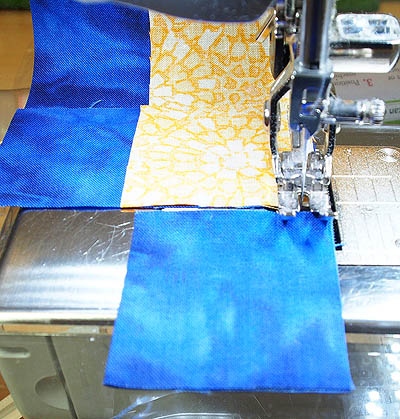
As I've come to learn, a leader is where one will put a small piece of scrap fabric under the foot to start the sewing off. It helps prevent thread from bunching up and essentially ending up with a bird's nest at the end of the fabric. An ender is a small piece of scrap fabric at the end of the piecing that ensures a ¼″ seam to the edge.

                             Use a piece of scrap fabric as the ender

You may have heard quilter’s talk about using leaders and enders. I had heard these terms many times and didn’t have a clue what they were talking about until I went to a trunk show last fall and was enlightened as to what they were. In the picture above you can see the different fabric at the start and finish of the chain – the leader and ender.

A quilter shared with me that "Leaders and enders are a great way to help ensure the ¼″ seam is accurate at the start and finish of piecing as well as eliminate some of those other issues we sometimes have. The best part is that you can create another quilt at the same time or at least get started on one."

These preventative or leading measures are how Peggy looked at leadership as well. Preventing issues that form as a result of early decisions; saving by eliminating what needs to be cut off; consistency; forcing you to clip what is not needed; pieces together additional items; and making things more efficient.

I have worked at camp and many of you know the 24/7 or as I call it 25/8 cycle of a summer season. Imagine that going on for nearly two years straight. And in the middle of all that Hurricane Katrina happens and Peggy decides to pack up half the staff and go help run a shelter for hurricane victims. This lesson that when you think you have troubles and strife; to be able to seek out those in worse conditions and say, stop what you’re doing, and we are going to help those in true need. That single action was one of the greatest lessons I gained from Peggy.

I am so grateful for those five years and those constant new challenges. It has given me a great appreciation to know that miracles happen every day. I learned that and so much more from Peggy as I have spent these past 50 plus years in these United States.

P.S. A link for actual quilting with leaders and enders.

Saturday, June 19, 2021

2003 - Leadership and Being the "Boss"


(Fifty Nifty Years in the United States series)

Wanda – Orville, Lisa and Amanda. RichardBach says, “The bond that links your true family is not one of blood, but of respect and joy in each other's life.”

I refer to Amanda as my “favorite child who is not my daughter.” The four of them became family right down to some of my favorite holiday memories at camp when our families would join us and spend the Thanksgiving weekend. 

Wanda was our cook while we were at Camp Edwards and Orville was our facilities person. They were raising their granddaughters, Amanda and Lisa. They were all devoted to the work of our little camp.

Often, Amanda and Lisa would come down to the camp every weekend in the winter that we had groups. They helped set up and clean up. They also became Alec and Kelly’s live in nanny and help. They became family. 

Amanda (Top left) Kelly (top right) Lisa (lower Left) Alec (lower right)

When Wanda passed away in 2003, I shared some of this at a memorial.

Here’s what I know.

Camp is about beginnings and endings. And I want to share a bit about my beginnings with Wanda. “Live your life while you have it. Life is a splendid gift. There is nothing small in it. For the greatest things grow by God’s law out of the smallest. But to live your life to the fullest, you must discipline it. Make your thoughts, your acts, all work to the same end, and not self, but God.” When I think of how much Wanda lived her life, I always go back to those words from the Blue Rag ceremony (the Rag program is something mostly done at YMCA Camps).

I believe that from the start Wanda would have worked at a YMCA camp. She was bound to see those words and sooner or later demonstrate to us all that it was her way. She had a rich and full life. I am sure that she shared it with all of you in her way.

She was by no means an easy person. She had her extreme side and some of you have seen and felt that as well. I am sure that those who worked with her; each of you has your own “moments in the kitchen with Wanda.” Moments when she would come in and tell you what needed to be done, what should not be done and what we should have done relating to some challenge in our own life.

I learned about her life this way. I learned all about it; all in the first three full days we spent together at camp. Those words I shared above by Richard Bach - I believe them to be true especially of the family that I gained by working with Wanda. Not only did we share in our work, we shared our lives together.

I remember when I arrived at Camp Edwards on that week in February 1998 when we had our biggest El Nino storms. Wanda had spent some time sharing about the ins and outs of camp; showing me how things worked; how the snow blower worked and how to plow the road. She got in that big old stake bed truck and off we went on that 1/8 of a mile, making sure that there was room to park all the cars for the Indian Guides (that’s what Adventure Guides were called at the time, also a YMCA parent child program) that next week. She showed me a lot regarding that plow.

Then later that afternoon she told me that when it began to snow, I should go out every couple of hours and plow through the night, so it would not be overwhelming. Well it began to snow, and it snowed and snowed and snowed. Wanda said good night and I went out and started plowing. Every couple of hours I plowed.

It was around midnight that the heaviest snow was dumping. I could hardly see out of the windshield. I rolled down the window of that truck and the snow was coming up from the blade and right into the truck. I got to the top of the road and rolled out and around to start coming back into camp and that’s when it happened. There was so much snow on the ground that I got stuck. I kept thinking, “This can’t be.”

I started reviewing in my head what Wanda had showed me when we plowed the road with two inches of snow on the ground. I had put it in four-wheel drive, I had put the plow down, and I even knew how to switch tanks from gas to propane. I sat there for a while and thought, “She never said anything about chains, I wondered if you need them in this much snow.” Needless to say, that the truck was stuck, there was over four feet of snow by morning; the power was out, the phone lines were down. We were trapped.

I got to know Wanda. She loved to talk, and she loved to share about her life and her family. I got to know all about her, so much so that what developed there became the international camp sign for over share. (hold both hands over your head in a circular fashion thus making a giant “O”)

Wanda had quite some life. Those who knew her know all of it. In the first ten minutes that you meet her, she had spilled out most of it to you and was asking about your life, family, finances, how to buy a car, mortgage a home and most especially how to adopt your grandkids. She loved to share those thoughts and ideas and the things that she learned on her way.

“We believe the best and happiest life is the one spent not for self, but for others.” This line from the Red Raggers’ Creed to me best describes the commitment that Wanda had to our YMCA camp community and to her family. I believe that she thought that those two families were one and the same. Our family’s not only shared work, but we shared our lives.

We spent holidays together, we spent work days together. We saw the best of each other and the worst. I remember countless times that something would happen, and I would come into the dining hall, day or night and Wanda, had just arrived before me or when she arrived she put on a pot of coffee. Often wearing one of those colorful Moo Moo’s with red floral print or tiger print. I know those who know here can all picture these.

They were part of what made her life so colorful. Some of those prints were as vivid as the way she described aspects of her child hood or marriage or life living elsewhere off the hill (Mountain folks in So. California refers to living on “the Hill”). It always amazed me how she had a story or advise to relate to anything that could possibly be happening. 

She made life a splendid gift. It was these times that we shared our conversations. I would talk about the challenges we had at camp and related them to my own personal challenges. We talked about my goals for camp and while she may not have agreed with everything I did, she always supported everything. It was in these talks and then in times when I had to be a supervisor that I gained the most from Wanda.

I remember about the third year at that camp during our annual evaluation, Wanda shared with me that she had learned so much in the past year and she thanked me. She thought that at her age and with the lifetime of experiences she had figured a lot of it out. But I helped push her out of that box and try some different things. Needless to say, she pushed back sometimes, and we had our struggles. But there is nothing that I would ask her to do that she would not be willing to do and if not able (get Orville to do).

It’s not until some time after that I realized that Wanda had really been listening to me in those first three days. I had told her about my experiences in my previous YMCA work. Its funny thinking about it now, but how much each challenge she and I faced or new way we discovered to work together, that she gave me the opportunity to change the way I supervised.

The mistakes I made before she afforded me the chance to do differently and be a better supervisor. She started calling me "boss" because she said it was a way for her to acknowledge me, since she did not always remember names well. I would always tell her in those early days to call me Al; after all it was only two letters to remember.  But like a lot of things, she insisted on her way and the name stuck.

I used to think that a boss was someone who was overly demanding, and I had visions of someone overseeing an assembly line in a factory for 14 to 18 hours a day. I guess that’s not far from the kitchen at camp in the midst of summer. 

Over time, I learned that it was out of respect and caring that Wanda used those words. I came to believe that it was perhaps the highest honor I would be given is to hear Wanda and later Orville calling me “Boss.” It all stems from what John Maxwell calls the "Law of Connection."

There was so much grace that they allowed me to make mistakes and try different things and learn from those mistakes.  I am extremely grateful for those opportunities and the family members we gained.

Just a few years ago, Amanda and Lisa came and shared a Christmas with us in New York. And just a few Thanksgivings ago, we spent the weekend with Amanda and her daughter at her home in Maryland. She still calls me “dad.”

It is an amazing gift as my family and I have traveled along the way over these last 50 plus years in these United States.

Thanks for letting me learn to be a “boss.”


Monday, June 7, 2021

2002 - Leadership and Laughter


Shmoo (L 2004 and R 2021)

(Fifty Nifty Years in the United States Series)

I have said and maintain that Brian makes me laugh every day. Even on days that I do not see him, I often have a thought or memory that brings a smile to my face.

I have also said that 67% of people who have a third child do not have a fourth. (Mostly because of the third). I also like to say that 57% of statistics are made up. It is the third child that forces your hand to go from a (Basketball reference) man on man defense to a zone defense. You are always outnumbered.

Evidence that 57% of stats are made up.


I often cannot recall when Brian was not around, but it has not quite been 16 years yet. I think of our family experiences and sometimes I have to recall if it happened prior to his birth. It is because he is so ingrained in our lives.

When Brian (or as most of us call him, Shmoo) was about a year and half that I realized how much command he has in all our lives. There were so many times when nearing bed time, I would say to Brian, its’ time for bed. He would get up dutifully and wander into where ever Alec and Kelly were and announce to them, “Alec, Kelly, it time for bed.”

They trained him well, because they would get up and get ready for bed. Later they realized the mistake and that he would always win out when telling them what to do. Not because Lee Anne or I would enforce that he had authority; it was that they had always dutifully done as he commanded. 

John Maxwell says "Leadership is influence, nothing more, nothing less." It's the second law in John's 21 Laws of Leadership. At the age of two, Brian had this down with his siblings. John states that "It is not about you, it is about them." And Brian had this figured out. They would listen to him and he had his influence over them.

At 18 years of age and about to graduate high school, Brian still has his areas of influence. He is his class president; he is in the band, choir and drama club (often with primary roles in those media; he loves Model United Nations and has had a leadership role in that as well. 

While he is the last child, he is the first in so many different ways. Brian learned John's second law early and I hope will not have to keep re-learning it later as many of us have had to do.

I am grateful for all my children and for the lessons they bring. In my 50 plus years in these United States, I have embraced (with family and career) the fact that "people don;t care how much you know, until they know how much you care." 


Thursday, June 3, 2021

2011 - Leadership and 5th Grade Rules!


(40 Summers 40 Lessons Series)

I have spent nearly 11 years (of my 40) working at different camps helping to provide Outdoor Environmental Education with different schools in California, Florida and New York.

Most of those schools sent fifth grade classrooms (with some exceptions) as part of their science and learning modules. Some of my favorite times and greatest learning happened in 2011 with an exceptional team of leaders who are all still working in some capacity as youth development professionals. (Matt Sheah, Paul O'Brien, PattyHart, Laura Kerigan, Amanda Dove, Steve Waterman, Paul Cary, and Zach Tarbell)

I think back to my own fifth grade experience here in the United States and it was perhaps the best year of my elementary education as well. In another BLOG, I wrote about Mrs. Fox, my fifth grade teacher and all the great stuff we learned from her that magical year. I shared the picture below of some of those lessons:

My lessons from 5th grade.

Happy 5th graders like to learn at a different rate than they did just the prior year. Hank Pellissier who writes on education and brain development has shared that "By fifth grade, your child’s brain has created a unique "self" due to its one-of-a-kind neural pathways. The upgraded analytic ability also enables fifth graders’ noggins to become keenly, painfully aware of how they fit, or don’t fit, into certain social groups. Partnered with dramatic imagination, your child may feel lonely and unaccepted, a social failure with fragile self-esteem." (See the full article here)

Having led hundreds of outdoor environmental education sessions at four different camps over the last 40 years, this is the age group I greatly enjoy when it comes to learning.

That "fit" that Pellissier mentions comes off as an exuberance of learning new things. By the time those same students are in sixth grade, their awareness to social pressures diminishes their love of learning. The love may still be there, however they are less likely to show it in any group setting for fear of being misjudged.

The opportunities to attend summer camp and outdoor education session has diminished over the past year. As circumstances change, I highly encourage those educators and youth development professionals to embrace fifth grade learning and think about ways we can share those in person experiences again.

While the growth in their prefrontal cortex grows; the passion to learn in a outdoor setting can really set the stage for science, math, and outdoor activities that will last a lifetime.

Putting students in an outdoor setting (that often times are their first experience "on their own" without parental influence) brings those fifth graders into a cross road of imagination and learning. 

I recall so many nature hikes that brought students face to face with a tree that had been through a forest fire and asked them to use their imaginations on what they see about the tree and what they can learn about life.

Or that giant Champion Lodgepole Pine (I wrote about on a previous Blog 1989- Stewardship) where 10-12 youth could hold outstretched hands and while holding hands wrap around the base of this tree. We would hike past the tree to a neighboring meadow where we would look back and have a somewhat unobstructed view of the entire tree. About a third of the way up, the tree split into two different trunks. It was estimated that the tree was hit by lightening at the time of the Revolutionary War and grew in the split trunk format from that time forward. The absolute wonder of looking at a thing so big that has lasted as long as the United States has been around.


Nature P (Paul center) and OE students circa 2011


While you may not be able to keep your child safe from some scary places in the world; you can gift them with an opportunity to share the wonder of an outdoor setting. Consider a outdoor education session through your school or local camps in the United States (Find a camp). 

There are also hundreds of free and fee based lessons available online at sites like Outdoor Families or Project Learning Tree.

Here's what I know; FIFTH GRADE RULES!


Monday, May 31, 2021

2001 - Leadership and Significance


Amy Larson (Circa 2000s)

                   (Fifty Nifty Years in the United States Series)

People at camp do things that perhaps they do not do anywhere else in the world. Amy Larson is one of those people. There is not a task at camp that was beneath her. She would do or say anything that needed to be done in order to advance the cause of children having a great time at camp.

She also had a collection in a plastic box of foot skin – her own. (dried skin from her heal that would peel and she kept in a plastic box in her desk)

Again, people at camp do things that perhaps they would not do anywhere else in the world. Amy was another one of those fixtures who had been at one of the camp's I directed in California. 

Amy's family had also been Y folks and her grandfather was a legend at the Y in their community. Her enthusiasm was marked by a long labored want to share about her ideas and philosophy of camp. After an extremely lengthy amount of coaxing and intense relationship building (17 minutes) she exploded with what I found to be a leader waiting to happen. I joke about this because those who know Amy, know that it does not take a great deal to illicit her reactions, opinions or exuberance. It was absolutely what I was looking for in helping me shape camp.

Our couple of summers together and her help and support during the off seasons and winter programs where a truly special time. Amy’s gift to me was that she allowed me to help her through decisions and growth and great life choices.

I felt like what I thought it might be like for some of my mentors might have felt. A satisfaction of seeing someone discover their life’s potential. In service to youth. It was what I can only describe at the time as feeling significant in another person’s life. I am not sure I had shared that with Amy and it wasn’t until my role changed in 2001 that I missed her gift.

John Maxwell says, “Once you taste significance, success will never satisfy you.” 


Amy will never know (unless she reads this) how much she enabled my desire to make significant changes that allowed us to serve an entire population of children that we had never served before. 

A the beginning of our time, that YMCA had three week long sessions of camp each summer. Inside of three years, we went to six weeks; and then to 9 weeks; and then adding on bed/bunk space, program areas, building a cabin, and even engaging another nearby camp for bunk space. We also added travel programs and surfing (beach) camp sessions.

At the time a significant leap in how and who we served. From a YMCA that primarily served youth from predominantly affluent neighborhoods; to the expansion county wide and serving a greater number of disadvantaged youth as well as youth in the foster care system.

I am so grateful for my time in these United States and for Amy who allowed me to help her find in herself what I knew was a great leader. 

Today, Amy is a teacher and a mother, and I am still inspired by her exuberance to share the world with her own children and the hundreds and hundreds that we served together.


Summer Camp Insights (May 16, 2026)

 Summer Is On It's Way Every camp professional has a camper they never forget. (Or more) Sometimes it’s because of what the camper survi...